

Ecclesiart is an online project that raises awareness of significant works of modern and contemporary art since 1920 in UK churches and cathedrals.
The selected works represent the diversity of high quality church commissions and reflect developments in artistic practice and ecclesiastical art and design. You can explore the collection using the tiles below or by using the Ecclesiart map.
We seek to encourage increased responsibility towards works which may be under-appreciated or at risk and hope that this selection of works provides inspiring and challenging examples of art in churches useful to any parish or individual wishing to commission a new work.
Download our new meditations for Lent from our Ecclesiart Resources which can be used individually or in groups in conjunction with Ecclesiart.
We welcome nominations of new works to be added to Ecclesiart. Please email us with a short text about why you think a work of art should be included with a short theological reflection on the work and its context (no longer than 150 words) and if possible please include images. Please note that we do not accept nominations from artists for their own work.
All permanent works shortlisted for the Award for Art in a Religious Context are added to Ecclesiart. For all other nominations, the Director and trustees of Art and Christianity reserve the right to select works which they determine as meeting the criteria of aptness to context, artistic and technical merit and appropriate theological meaning.
Search Ecclesiart

The architectural sculptor William Mitchell was commissioned to make the Stations of the Cross for the new Clifton Cathedral, built 1969–73 to designs by Ronald Weeks in close collaboration with clergy and theological advisors. The concrete church, almost entirely monochrome and undecorated, is notable for the success of its integration of the ideas of the liturgical reform movements of the twentieth century, and its expression of the principles of the Second Vatican Council – a ‘sermon in concrete’, in the words of Nikolaus Pevsner.

George Mayer-Marton’s work in mosaic for the Franciscan church of St Clare, Blackley, is one of several commissions by the Roman Catholic church in the north-west of England, but only one of three that survive.


Craigie Aitchison’s four Calvary panels for Truro Cathedral sit behind the altar in St Margaret’s Chapel. Bands of luminous colour – magenta, purple, emerald green – form the background, a simplified landscape. The first three panels are composed symmetrically. The two thieves slump on their crosses, one arm draped elastically over the cross-piece, each turned towards the central figure of Christ, who is depicted with his head raised and features cautious but peaceful. A ray of yellow light splits the deep pink sky in which a single star shines, while the Holy Spirit descends as two white lines. There are no human witnesses to the scene; instead, a black dog gazes up at Christ and a blue bird perches next to his shortened arm. The fourth panel shows, in the place of the Cross, a white, stunted tree, its single branch in bud. It is illuminated by a bright white orb – the moon, or perhaps the star from the second panel, grown larger . Aitchison has said of his repeated depictions of the Passion, ‘it is a horrific story, and I think more worth trying to say something about than anything that’s happened since.’ Here the horror is transformed into a strange and tentative hope.

Theo Moorman’s woven frontal was made initially for a side chapel at Gloucester Cathedral but was relocated to the small Norman church of St Mary, Syde, when the Thomas Denny windows were installed. Despite not being made for the church, the frontal suits its new home. The abstract composition suggests a ray of light shining out from the centre of the altar, infusing a landscape of blues with a soft yellow-gold light. The palette seems to gesture towards the church’s dedication, and echoes the Virgin’s robes in the modern window above, as if developing the symmetrical folds and strictly alternating green-gold pattern of the glass, as well as the simple floor paving, in its own, looser and yet rigorous way. The arrangement of colours and deviations from complete symmetry appear to follow a deeper logic that the weaving, as a work not just of craftsmanship but of art, makes visible.

Sutton Baptist Church was the architect N. F. Cachemaille-Day’s only known non-conformist commission; with its imposing, fortress-like brick exterior and spacious interior it is referred to informally as the ‘Baptist Cathedral’. The interior echoes the churches of German Expressionism with full height pointed arches. The architectural and liturgical centre of the church is the baptistery, against the east wall, with a pool of Hopton Wood stone and a brick reredos under a large window by Christopher Webb of scenes from Pilgrim’s Progress. Presiding over the pool, framed by two dramatic twisted brick columns, is Julian Phelps Allan’s sculpted relief depicting the Baptism of the Ethiopian.

St Laurence Church, Catford, is a notable octagonal church built by Ralph Covell in 1968. The east wall behind the freestanding altar presented a problem that for several decades remained unsolved. A plain cloth screen covering the organ pipes formed an unsatisfactory backdrop to the sanctuary, despite an illuminated dalles de verre cross in its centre. The space ‘was an empty vacuum – not even a positive absence – a negative space demanding to be filled’, as Charles Pickstone, the current vicar, has put it. Victoria Rance, an artist based in nearby Deptford, was commissioned in 2008 to produce a work that would solve this problem, with enough visual force to fill and unite the space without distracting from the altar and sanctuary.

The opening of English Martyrs RC church in 1953 marked the completion of F X Velarde’s (1897–1960) most ambitious post-war building. An expressionist brick basilica filled with colour and decorative elements; not added but embedded as intrinsic aspects of the architecture. As with all Velarde’s churches the detail was tightly controlled, work with artists being a collaboration. The most successful and longest of these collaborations was with the sculptor Herbert Tyson Smith (1883–1972).

These two marble panels by Tom Phillips (2003) flank the entrance to the Chapel of Holy Souls at Westminster Cathedral. They have since been joined by an accompanying mosaic depicting St John Henry Newman (2008), and a mosaic scheme for the ceiling of the adjacent St George’s Chapel (2016).

The Desert Window was commissioned in 2014 for the LSE’s new Faith Centre, an interfaith worship space as well as a centre for rigorous interreligious dialogue, research and training. The window’s subject points to the significance of the desert both as a place of spiritual intensity for many religions, and as a place of ‘inter-religious encounter’, in the words of the chaplain, the Revd Dr James Walters. The window thus expresses the role of the Faith Centre as a ‘place of stillness for all people, where different religious groups can “set up camp” for a while, but also a place to encounter people of other faiths, to hear their stories and to share hospitality.’

The original chapel of St Michael’s theological college was destroyed by bombing, and the architect George Pace was commissioned to design a replacement.

Nicholas Mynheer (b. 1958) and Roger Wagner (b. 1957) were commissioned to contribute to the enhancements programme at St Mary’s, Iffley, a Romanesque parish church in east Oxford.

The project for the ‘Black Madonna and Child of Covid-19 Lockdown’ (Our Lady of Kilburn) arose from the community’s experience during COVID lockdown. St Mary’s is a Black majority congregation, with most being women of working age. Many were aware of significant racial and gender differences in the effects COVID had.

‘Antony Gormley’s Transport in Canterbury is a large and striking human figure, created from iron nails formerly in the roof of the Cathedral. It is suspended three metres above the floor of the site of the first burial place of St Thomas Becket in the Eastern Crypt. [...] This is a beautifully made and very clever piece of work which impresses by its technical accomplishment’ (The Very Revd Nicholas Frayling, Chair of the judging panel for the ACE Award for Art in a Religious Context, 2011).

A highly detailed yet monochrome window depicting billowing clouds. This work was joint winner, along with James Hugonin's window for the same church, of the 2011 ACE award for art in a religious context.

Paula Rego’s pastel depicts St Margaret of Scotland with her son, David. Born in Hungary, exiled from England to Scotland under William the Conqueror, Margaret then married King Malcolm III of Scotland, abandoning a plan to become a nun.

Stephen Cox was the joint winner of the ACE Award for Art in a Religious Context in 2007/8 for this altar which was commissioned by the people of Aosta in Italy from where the piece of marble was excavated. St Anselm is buried in the chapel having been born in Aosta.

Contemporary window chronicling the North Sea Oil industry, with links to Aberdeen and in memory of all those who lost their lives in the industry. The window won a Saltire Award for Arts in Architecture.

Henry Moore’s Madonna and Child is a work of international significance. The sculpture is in Hornton stone and was carved for the church by Moore in 1943-44.

St Martin in the Fields’ East Window by Shirazeh Houshiary in collaboration with Pip Horne was commissioned as part of major redevelopments within the church and its curtilage.


Jonah Jones' concrete-glass window, baldacchino and mosaics are installed at the Catholic Church of St Patrick, Newport, Gwent. The large window shows the saint in purple archbishop’s vestments.

For these vibrant paintings, infused with rich colours and bold abstract shapes, Lovelace drew on the lives of the people and the flora and fauna of his native Trinidad. The project was accompanied by a new memorial designed by Cardozo Kindersley and placed near the font where Cugoano was baptised, its inscription including the title of his prophetic book.
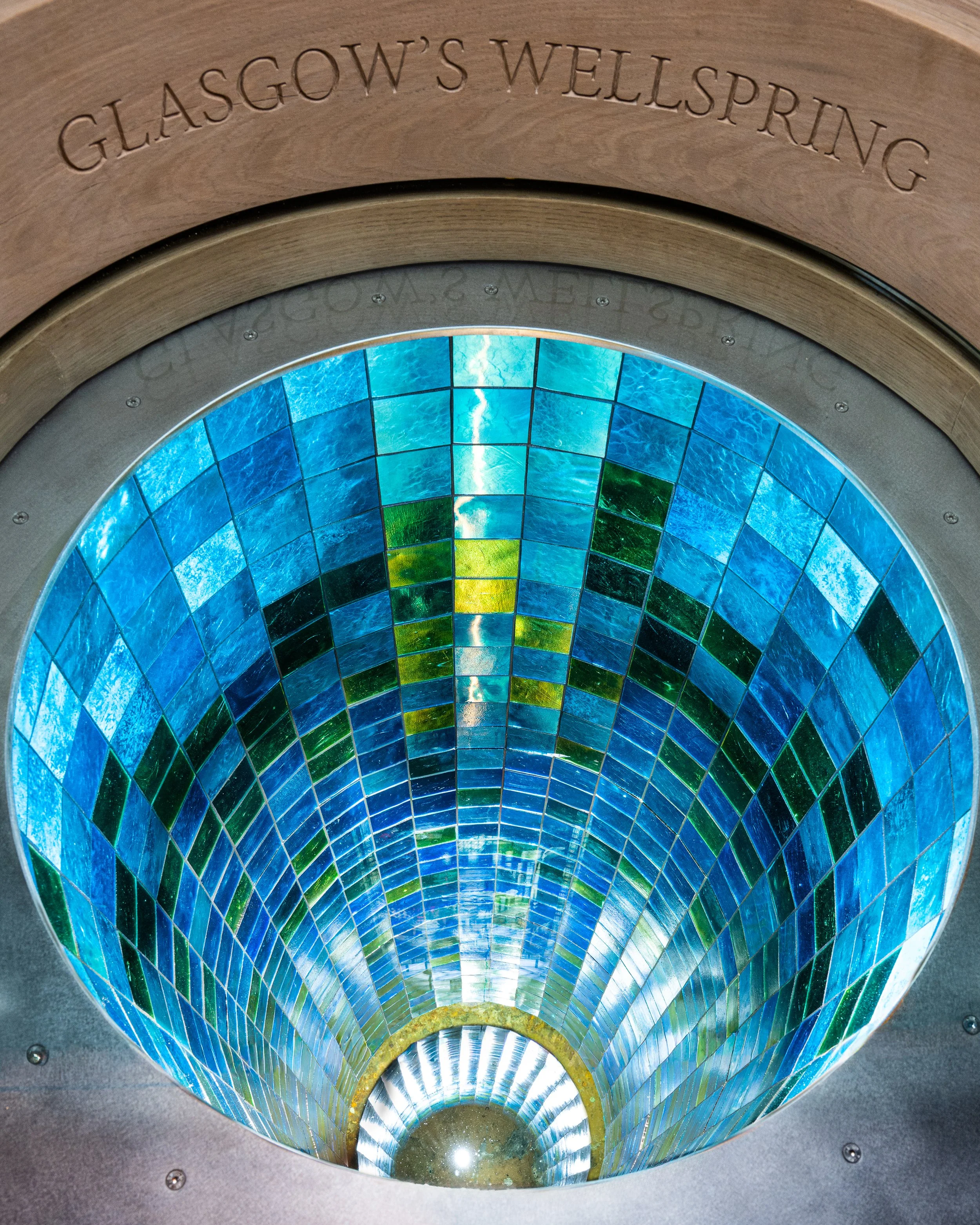
This hugely ambitious undertaking was logistically challenging, as we learned from Dolly Dean of Aproxima. Site preparations included removal of the hoard from the four-metre-deep well, which revealed a fascinating collection of votive offerings. Creating 1,000 handblown tiles of coloured glass, each inlaid with pressed gold leaf plates, involved cutting-edge construction: an aluminium honeycomb cylindrical form and the same material used on spacecraft shields and cladding for the Hadron Collider. The circular mosaic had to be fitted with millimetre-wide precision and was ingeniously lowered into the well without touching the sides or capped floor, using a specially constructed gantry.
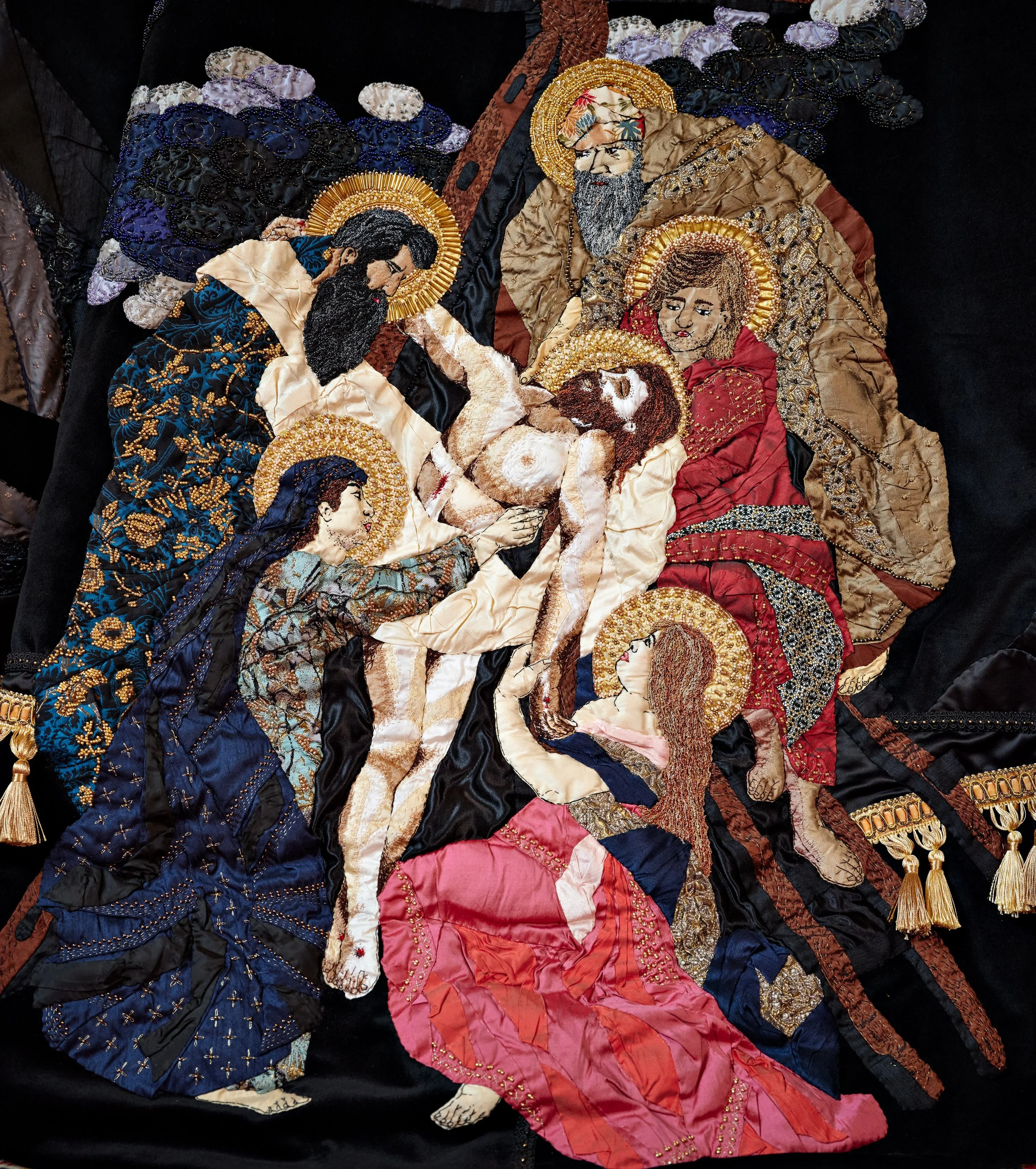
… The garments are not however merely decorative; they are theological statements, incorporating traditional Christian iconography, and are worn during processions for Easter and Pentecost to signify the dignity of worship and the continuity of sacred tradition.
Having this liturgical and spiritual function, they are described as “woven prayers that embody the Cathedral’s mission to unite artistry and devotion in the service of God”.
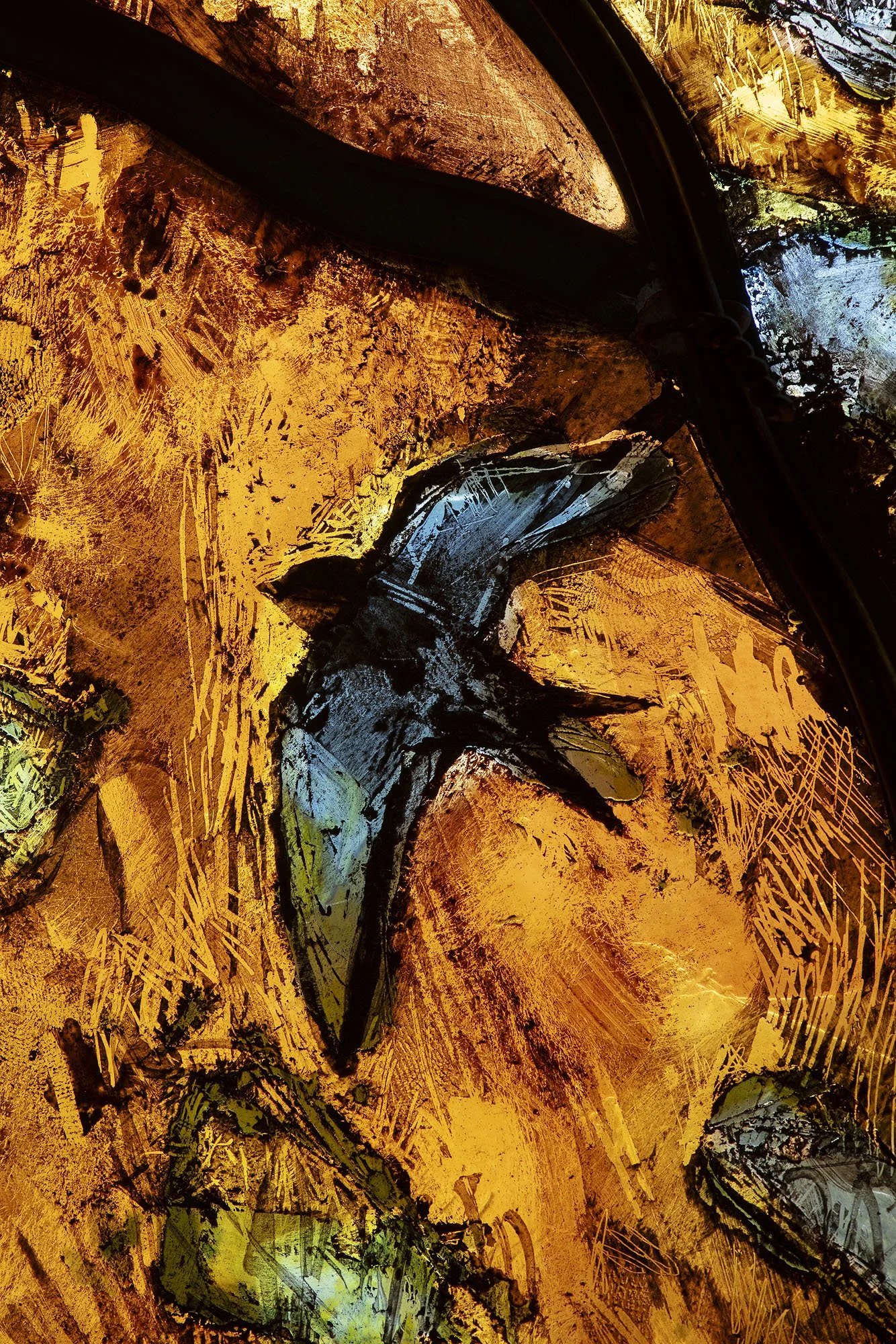
The theme of the window is ‘seeing’, interpreted here as “seeing the glory of God, and the epiphanies in ordinary and extraordinary moments in life”. The window bursts with stories, both biblical and local, with figures standing “transfixed by the mystery and meaning of their surroundings”. The story of the Transfiguration is expressed in the centre of the window, while renewal of sight, actual or metaphorical, is the subject of other scenes. Landscape recurs throughout, depicted with an intensity that evokes the work of Samuel Palmer. A continuous horizon suggests Salisbury Plain, scattered with clumps of trees and barrows; nature is abundant; and the ground is scattered with a rich layering of time.
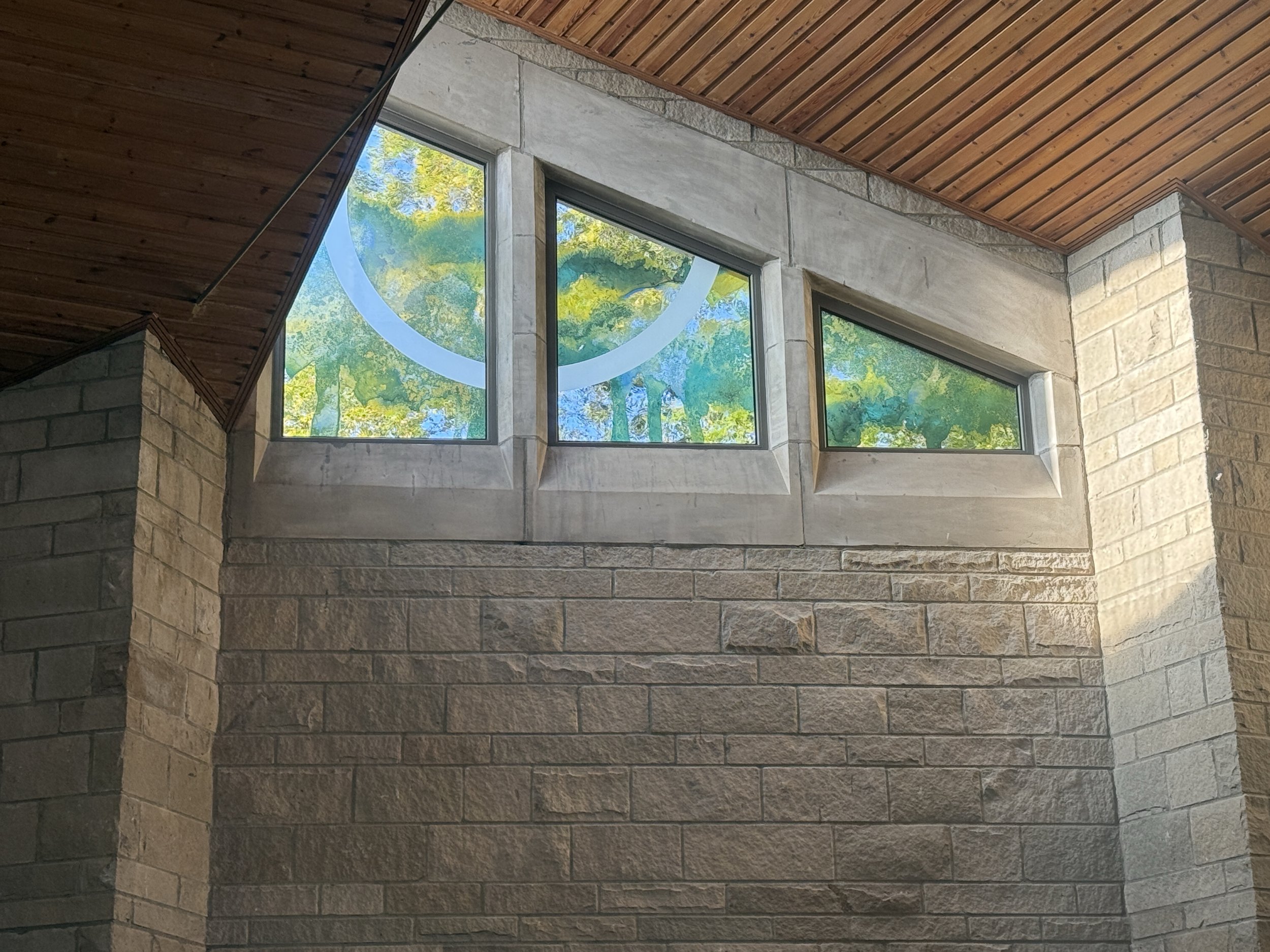
… Hacker experimented with different enamels, choosing a transparent type which, when combined in double glazed units with a specialist clear glass, provided the clarity and translucency the trustees were seeking, while also improving the priory’s ecological impact and significantly enriching the transmission of light into the chapel, as sunlight streaming in changes the atmosphere of the chapel throughout the day and the seasons.

The Chagall windows at Tudeley were commissioned by Sir Henry and Lady d'Avigdor-Goldsmid in memory of Sarah d'Avigdor-Goldsmid, their daughter who died in 1963 at the tragically early age of 21, in a sailing accident off Rye. Sarah d'Avigdor-Goldsmid and her mother had visited the 1961 Louvre exhibition of Chagall's work.

George Mayer-Marton’s Crucifixion mural at the Church of the Holy Rosary (1954–5) was one of several commissions by the Roman Catholic church in the North-West, but only one of three that survive.

Located on opposite walls of the aisles either side of the sanctuary in Liverpool Cathedral are two paintings by Adrian Wiszniewski: The Good Samaritan (south choir aisle) and The House Built on Rock (north choir aisle).

The murals at St Michael and All Angels were among the first works to be created by Hayward after he established himself as a freelance artist in 1961. Their blues, greens and golds were to become characteristic of Hayward’s stained glass for which he became famous in later years. The murals use the marouflage technique: the images are painted in the artist’s studio and then cut out and glued to the wall of the church. Each was designed specifically for the space it was to occupy. When they were installed in 1962, they were said to be the largest modern set of murals anywhere in the world.

The design is inspired by a 17th century map of the town and includes significant historical landmarks such as neolithic earthworks and an early medieval castle. The main road clearly marked on the map becomes a horizon line in the window. In the ‘sky’ above, a golden shape glows with light where the ruins of Ludgershall Castle now stand.

Pauline Caulfield has produced vestments and altar frontals throughout her career.
In 2018 she had an exhibition of Ecclesiastical textiles at St Augustine’s Church, Hammersmith, London.

In 1989 Stead was commissioned by the North Sea Oil Industries to design and make the fittings for a new Memorial Chapel in the Kirk of St Nicholas, Aberdeen: 40 chairs, a lectern, communion table, a minister's chair, a screen.

This work 'was created in honour of Bishop Michael Ramsey, and intended to reflect his theological interests, in particular his fascination with the Transfiguration of Christ... The window is in the South Quire Aisle and is 16x16m in size. This window is technically very assured and of high quality. Its location means that it can only really be seen at close quarters, and it is indeed very detailed in its depiction of biblical images.’

Created by Maggi Hambling for the High Altar at Winchester Cathedral, these tapestries, the artist’s first, were dedicated on 7 July 2013. Maggi Hambling collaborated with Ateliers Pinton – a French tapestry workshop in the Aubusson region which has worked with artists such as Picasso, Miro, Leger and Sutherland (for Coventry).

During WWII, Bishop Bell commissioned Bloomsbury group artists, Duncan Grant, Vanessa Bell and Quentin Bell to cover much of the church in extensive murals. Duncan Grant's The Victory of Calvary shows Christ in victory on the Cross. Jesus is not obviously suffering; here he is the victor, standing on a platform rather than hanging down. Grant originally depicted Christ unclothed, a decision which drew criticism from the Church, so he repainted a cloth around his waist.

One of many ovoid domes in the Cathedral which has been given imagery and decoration using mosaic. The works depict St Francis preaching to the birds and St Anthony to the fishes.

A semi-figurative mosaic on the East wall, with an unusual black background. John Piper’s (1903-1992, British) paintings mainly focus on the British landscape and churches.

Antonia Hockton's River of Life reredos at St Georges, Great Bromley, Essex adds greatly to the way the altar in the side chapel works. This was just what a parish church should be doing: engaging a local artist who explores the context and makee something new that flows into the altar and on to those who worship there, and although it may have seemed a lot to the parish, it was achieved relatively inexpensively.

Originally sculpted for the chapel at Kelham Hall in Nottinghamshire, and commissioned by the Society of the Sacred Mission, the Rood now sits in the south nave of St John the Divine where the SSM was founded in the 19th Century.

In 2000 Gollon was commissioned to paint 14 Stations of the Cross for the Church of St John on Bethnal Green, a grade one listed building designed by Sir John Soane. This was one of the largest commissions by the Church of England in recent times. Although previously Gollon was not best known for his religious work, the Rector Alan Green explained, "The church of St John on Bethnal Green has had a long-standing involvement with people on the fringes of our society, the sort of people who often figure in Chris' paintings.

Ceri Richard's reredos and stained glass were conceived as a single triptych, abstractly flowing one into another. The tabernacle has more obvious imagery: the heavens, the chalice and the cross.

This window was designed by Eduardo Paolozzi, who was born in Leith, to replace the plain glass rose and lancets in the Resurrection Chapel. Given in memory of Mary Carmichael, a much loved member of the congregation, it was dedicated in October 2002. When the sun floods through the window, it transforms the plain stone and woodwork into a kaleidoscope of colour.
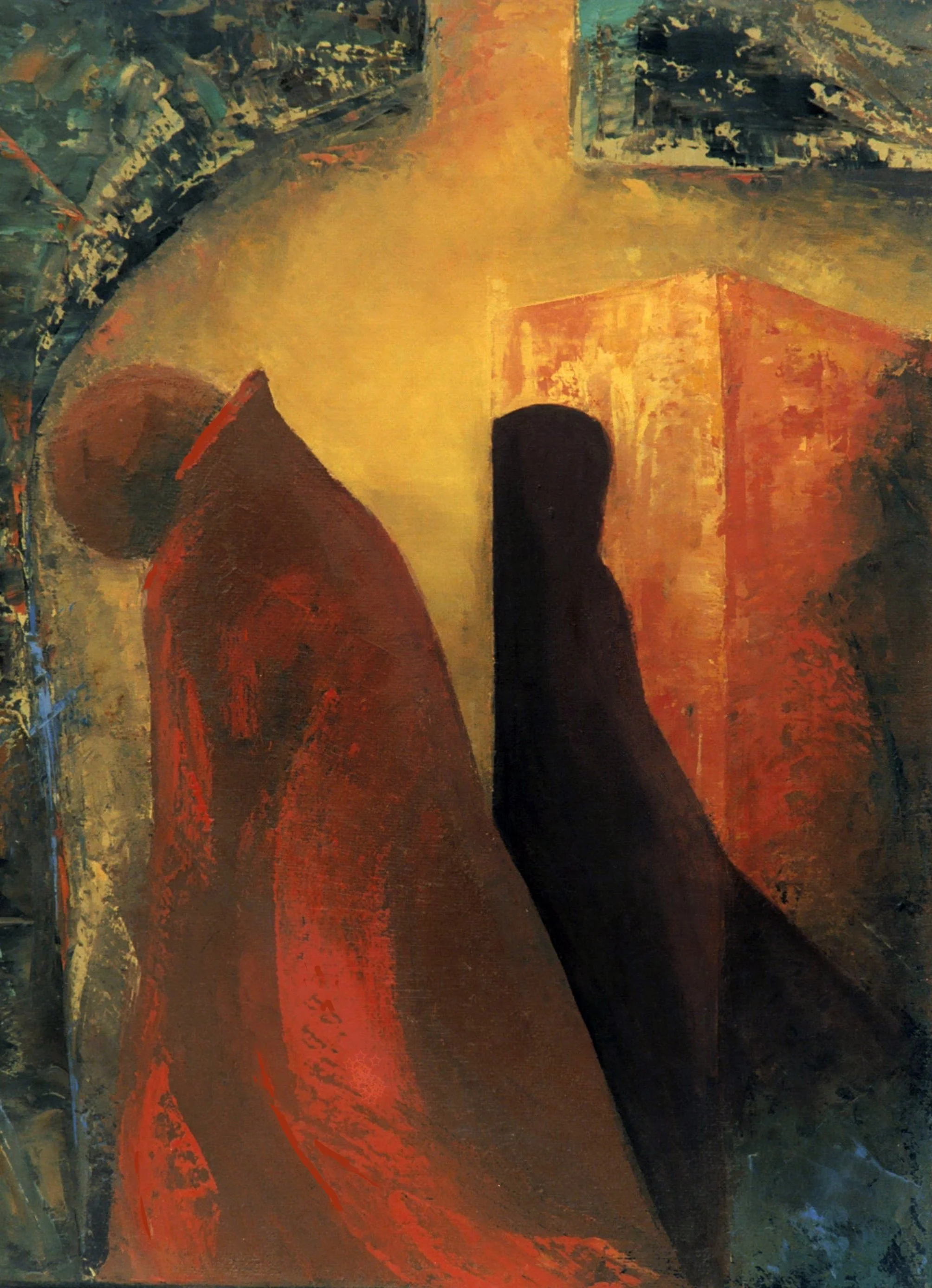
The paintings integrate theologically with existing features, and express the fullness of the Maundy Thursday, Good Friday, Easter and Pentecost story. The sheer size of the work assists in seeing and understanding the size of the work of Christ, with darker lower sections focusing attention on the ‘darkness’ endured in the Passion, and the brightness of the upper sections lifting the eyes to resurrection, light, life, empowering and hope.

Behind the altar table in Holy Trinity Church in Blythburgh, Suffolk, is a powerful altarpiece by Laurence Edwards. Cast in bronze from the mud, wood and hogweed that can be found all around the Suffolk locality, Edward’s sculpture brings the precise beauty of the outside marsh into the church in a way that combines imagination, emotion and spirit.
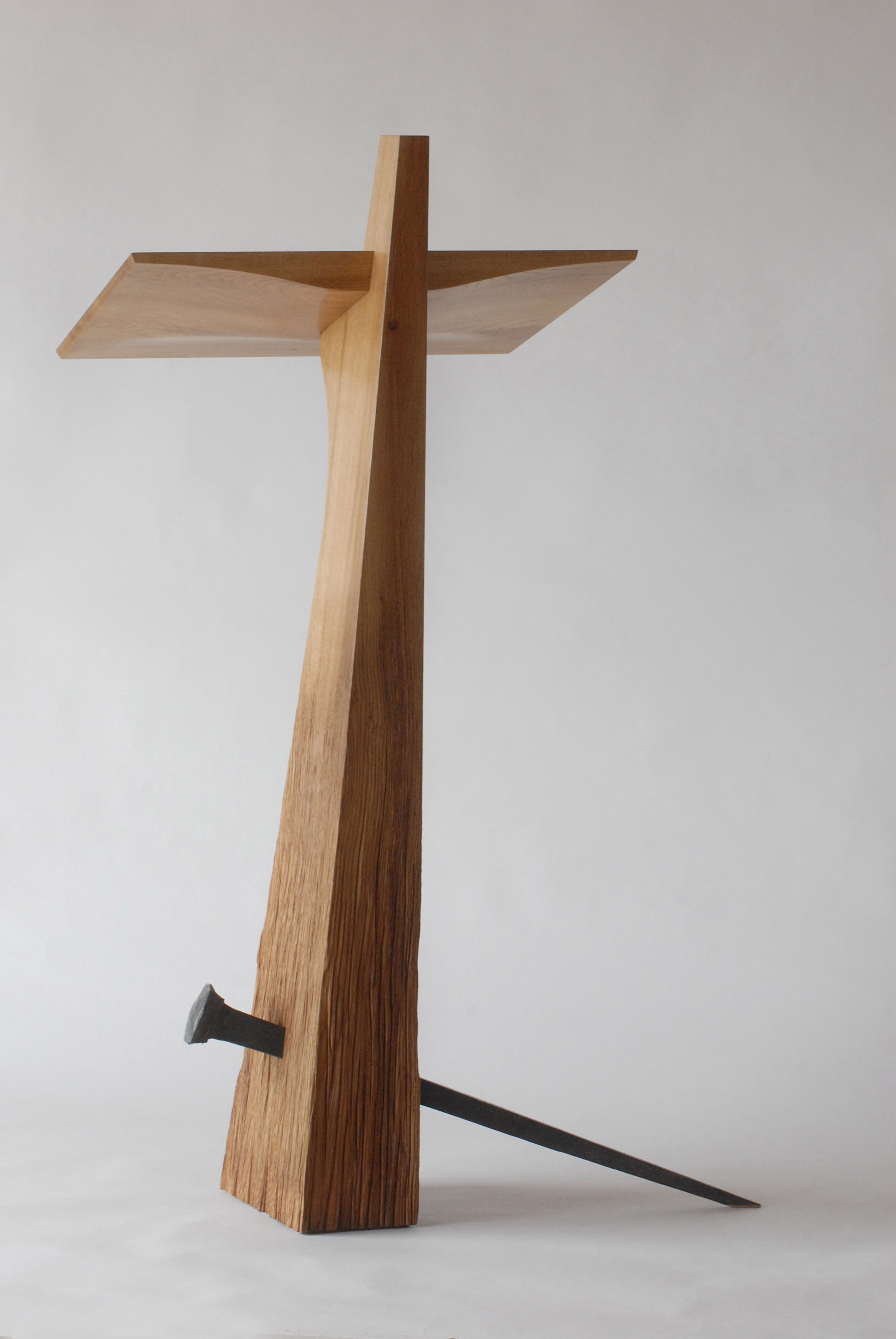
Winner of the A+C Art Award for a permanent commission, Stephen Owen’s carved communion table and lectern are powerful symbolic pieces of liturgical furniture.

In response to the invitation by the Westminster Cathedral Art and Architecture Committee to Giacomo Manzu that he should produce a low relief bronze wall panel showing St Thérèse of Lisieux for the Cathedral, Manzu submitted a sketch in 1956. This was immediately approved and the commission awarded. Manzu then proceeded to design and produce the bronze in Italy with casting taking place in Milan.

A triptych of modern stained-glass windows hanging in Gloucestershire Cathedral's South Ambulatory Chapel, the central one recalls the story of doubting Thomas, while those either side are abstract articulations of Psalm 148 which praises God's creation.
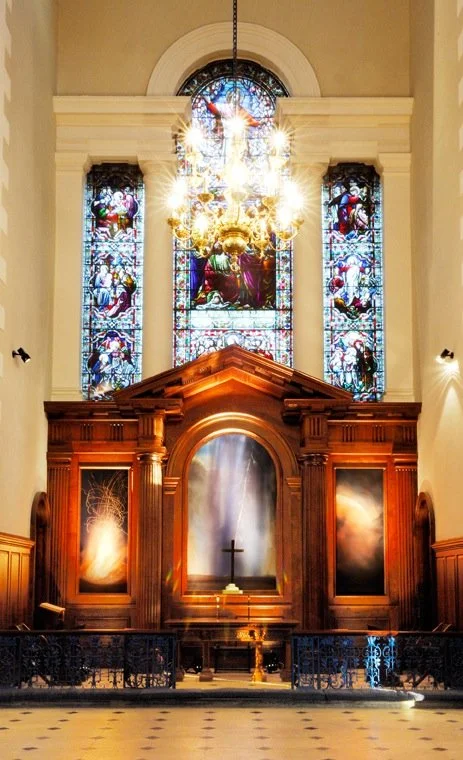
"Scintilla is a visual orchestration of life, made to echo inside the tall paleness of Christ Church Spitalfields. An evocation of landscape and elements that wants to summon the potent majesty of natures shifting energy to the core of Hawkesmoor’s poised linear order."
Nominated by Brian Catling

The altar that stands solidly as the ‘centre-point’ in the Resurrection Chapel around which the Community of the Resurrection and its guests gather on most days for the celebration of the Eucharist was designed and sculpted by Nicholas Mynheer.

This striking sculpture gives a dynamic focus to the church which takes a simple tent-like form. Behind the austere altar table the outstretched arms of the reflected figure invoke a well-proportioned ellipsis on the east wall.

The main features of the sanctuary are the Reredos and the stained glass windows... The Seven Angels Reredos was designed and worked by Susan Riley. Commissioned in 2000 it took two years to complete and was inspired by the angels of the seven churches to whom letters are addressed in the first three chapters of the Book of Revelation.


In 1970 the church of St Anselm's Kennington planned to redecorate its interior and invited Norman Adams to paint murals for the two side walls. After some deliberation between Adams and the Vicar at the time, Pilgrim's Progress was settled on as a theme and Adams undertook an abstract series working from dark to light in a modern yet expressionist manner.

All Saints Newland, known as the Cathedral of the Forest (of Dean), is also in the Wye Valley. Thus Beryl Dean used imagery of foliage, fish, water weed and snails for this Festal Set. The detail and design are both meticulous, charming and compliment the architecture of this rural church.

This speaks of unity of sound and glory. It is a universally accessible symbol, as was specified in the artist’s brief. They themselves echo the Grassin case design which features a fish (or Ickthus) motif on the front of the closed case. The four fish – two on the left and two on the right are Christian symbols which, in turn, enfold the circle within.


Known for his many commissions included murals for the Festival of Britain in 1951 and Manchester Cathedral in 1963, Carel Weight was strongly guided by the specific locations of his paintings.


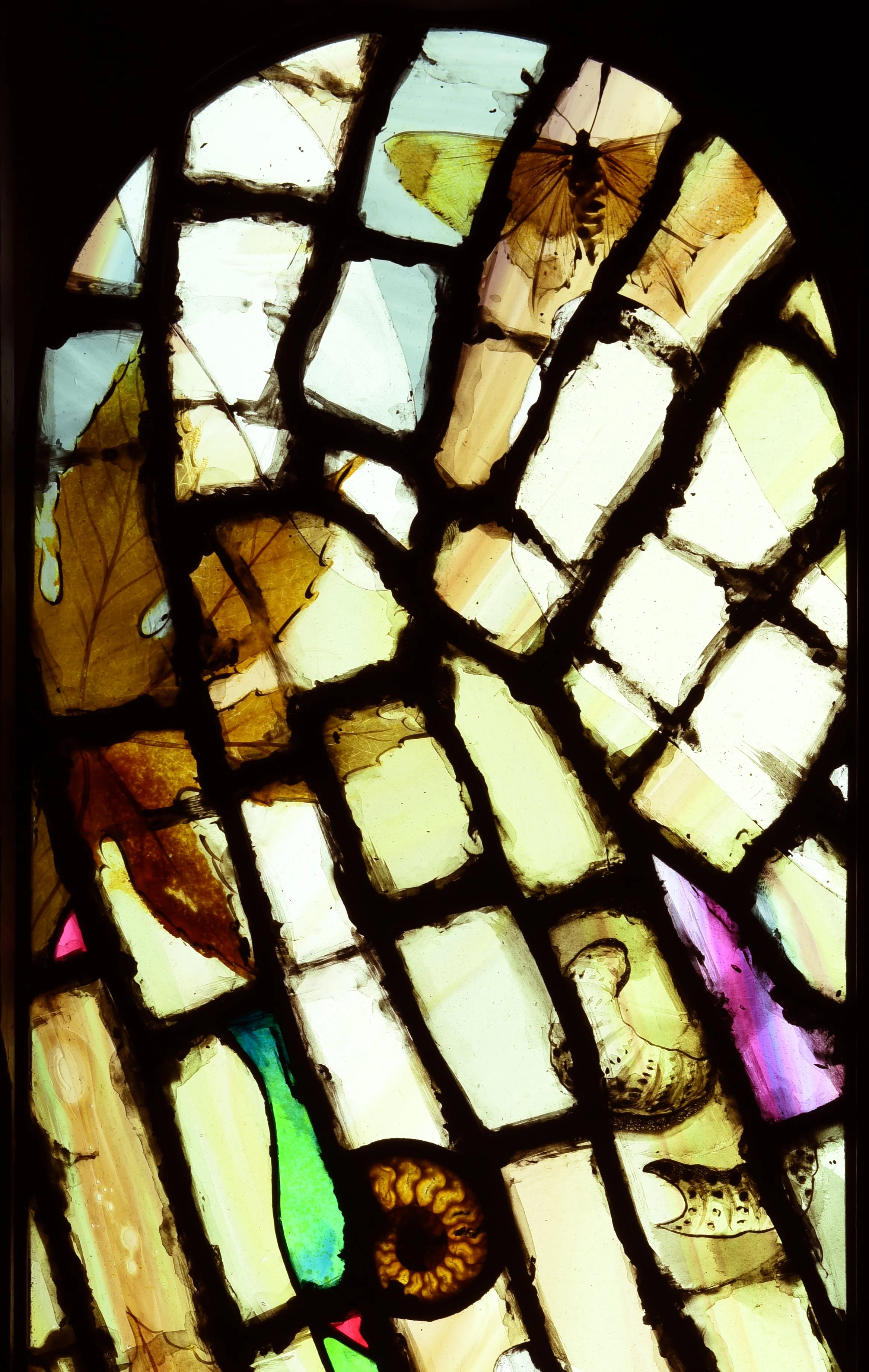
In 2015, Leslie Smith, the then Chairman of the Friends of Godmersham Church, approached the stained glass artist and conservationist Léonie Seliger with an idea to create new glass work for the church in memory of his late wife, Sue. The two windows at the apsidal east end of the largely unadorned North Chapel were chosen. The PCC soon approved the designs, which are a gentle celebration of nature and which recall the pattern made by exposed stones and their dark mortar joints fixed into the limestone arch above.


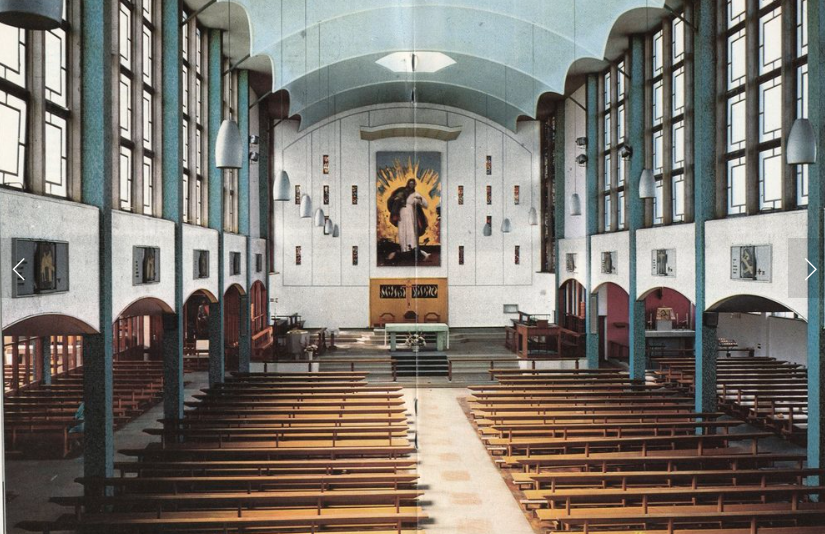
Painted in 1961 for the Church of the same name, Mary is depicted as the strong Mother of Mankind. The child, sleeping peacefully on her arm, represents humanity undisturbed by the chaos of the world, shown in the blazing explosion of the background.

Two windows installed in the Gibbs nave of the Cathedral. All Saints is the East window of South aisle and All Souls the east window of the north aisle.

This new, modern church was a collaboration between the architects Greenhill Jenner and Portal Architecture commissioned to replace the original church destroyed by fire in the 1970s.

Following a major refurbishment in 2010 it was apparent the reconfigured space lacked visual cohesion. Monsignor Curry wished to commission suitably qualified artist-designers to produce a new, unified scheme of furnishings.

The murals at St Michael and All Angels were among the first works to be created by Hayward after he established himself as a freelance artist in 1961. Their blues, greens and golds were to become characteristic of Hayward’s stained glass for which he became famous in later years. The murals use the marouflage technique: the images are painted in the artist’s studio and then cut out and glued to the wall of the church. Each was designed specifically for the space it was to occupy. When they were installed in 1962, they were said to be the largest modern set of murals anywhere in the world.

Mural covering the walls of St Benet’s Chaplaincy, Queen Mary, University of London.
Adam Kossowski (1905-1986, Polish) was a Polish refugee who quickly made a career in public works of figurative art in Britain.

Wagner's major work, Menorah, Depicts the crucifixion in front of the Didcot power station. Menorah was acquired by the Ashmolean Museum in 2010 and hangs in St Giles Church Oxford.

Intensely theological it addressed big issues of the day and asked questions of us about meaning, life, death and what we would give our lives for.

The large onyx disc was installed as a gift on the north west lawn in the Close of Salisbury Cathedral but has since been transported elsewhere. It is made of one billion year old, semi translucent onyx and is around two metres tall.

Light of the World is vast stained glass window, fully architecturally integrated in the Chapel of Robinson College, Cambridge.

Cocteau completed the murals between the 3rd and 11th November 1959. The theme he chose to depict was the Annunciation, the Crucifixion and the Assumption. It is said that he spoke out loud to the characters as he was drawing them. While painting the virgin he is quoted as saying, ““O you, most beautiful of women, loveliest of God’s creatures, you were the best loved.

Reconciliation Reredos is a contemporary artwork of universal reconciliation, that responds to the church’s past, reflects the voices of the city today, while representing the potential of the future.

Made from silver and plated with gold, this abstract work represents a phoenix rising from the ashes.

Still Point is a meditative spatial work incorporated into the cathedral grounds. It has three associated parts: a stone element, a poem and a song.

The artists own feminine handwriting - a rare element of Christian iconography - reads 'I Felt You And I Knew You Loved Me'.
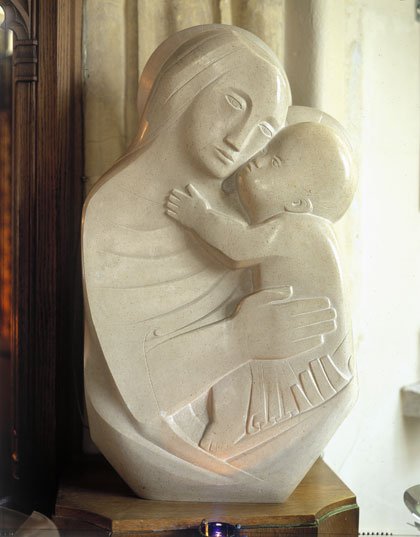
Barbara Hepworth’s Madonna and Child was carved in memory of her son Paul who died in an RAF plane crash over Thailand in 1953.

Frank Roper's candlesticks and crucifix are a two-tiered furnishing set upon a hexagonal base. The use of geometric shapes is again referenced in the lower tier through the use of the octagon. However, the smaller scale of this tier in comparison to the base may contribute to an emphasis of height. The upper tier is circular and performs as the base for the actual candle fixture and is stabilized by three intricate buttresses.

Rona Smith’s North Window panel is constructed from a web of whirling squares suspended in the window alcove. The squares spiral out from a central 'eye' whilst the panel itself curves into the space forming a sculptural arc which echoes the two dimensional pattern.


In 2014, Ripon Cathedral acquired an installation acknowledging the Great War. ‘A Tribute to Wilfred Owen’ by Charles Gurrey is set on the wall above the altar in the chapel of Peace and Justice at the west end of the north aisle of the nave in the position of a reredos.


A remarkable exterior mural painted on ceramic tiles by the relatively unknown artist William Gordon. The church was designed by Sir Basil Spence (one of two in Leicester) whose preference for commissioning artists of some calibre is exemplified at Coventry Cathedral. Here, in this budget-limited post-war church, his faith in one artist to produce such a large and impressive mural emphatically shows his perceptive and encouraging patronage of artists of different ilks.

The canopy has been in place now for nearly 40 years and still offers a valuable visual stimulus within the building; catching the evening light at the west end, providing a very helpful teaching aid for school visits and sermons alike, along with being such a clear visual representation of the nature of Christian life and initiation.

Beryl Dean’s Festal frontal for King’s Lynn Minster is a joyous and rhythmic assembly of symbolic motifs on an off-white silk background. The photographs showing details of the embroidery reveal crosses of silver, red, gold, brown and white, encrusted in beads of sequins, sometimes encircled by gold braid.

Mary Adshead’s dynamic mural, To the End of Time, takes up the entire east wall of the parish church of St Francis, Luton. At its apex is Christ’s bowed head, with the symbols of the four evangelists surrounding the cross, and, at the base, scenes of the modern world.

Intended to resemble the Hagia Sophia, with a monumental concrete dome, the neo-Byzantine St John the Baptist church was built in 1927. The interior is dominated by a magnificent mosaic scheme which covers the sanctuary apse, designed by the art critic and artist Eric Newton for Ludwig Oppenheimer Ltd., a mosaic firm set up by his grandfather. The scheme, which took a year to build, draws on Newton’s considerable knowledge of art history and his study of early Christian mosaics, although there are echoes too of more recent religious art, such as the prints of William Blake.

Elisabeth Frink’s bronze lectern for Basil Spence’s Coventry Cathedral was her first major commission. She was known at the time for her sculptures and drawings of birds – one made while she was a student was exhibited in 1952 and bought immediately by the Tate Gallery – and the lectern was to take the traditional form of an eagle.

Hans Feibusch, a Jewish artist who fled Germany in 1933, became the most prolific muralist in the history of the Church of England. Through his relationship with George Bell, the Bishop of Chicester, he created murals for many churches, often those built or restored after the war. His murals combine the palettes, techniques and forms of European Modernism – Expressionism and Cubism – with those of the early Italian Renaissance, while speaking to the spiritual concerns of the post-war church. Feibusch saw his work as essentially collaborative – not only with his assistant, Phyllis Bray, and the architect, but also with the worshipping congregation. ‘A work of art in church is there to help the worshipper, to lead their thoughts from the tumultuous outer world towards an inner spiritual one.’ (Hans Feibusch, ‘Mural Painting in Churches’, Studio, 1954)
Hanging Pyx was finished and installed in 2011. It is constructed from fabricated Gilding Metal and nickel plated hot forged copper. The whole piece is 96 cm high and hangs 5 feet above the altar in the Lady Chapel at Holy Trinity. It works on a rise and fall mechanism located 8 metres up in the eaves of the roof, utilising 50 metres of 1.5 mm diameter stainless steel cabling.